
Delete Attachments (Statistics)
Our Features
Structure your content
Delete all attachments
Multiple attachment remove by page for Confluence.
Delete with permissions
Allows deleting all attachments if an executor has permissions.
Filter attachments by date
If there are many attachments to be removed, it can become very painful to remove one by one.
Getting Started
Documentation
Delete attachments in a Confluence page
Available from any page’s
••• → Delete Attachments action, this focused tool cleans a single page without leaving it.
– At-a-glance summary — attachment count, combined size, and the estimated space held by non-current (old) file versions, presented as clear stat cards.
– Delete all — remove every attachment on the page in one confirmed action.
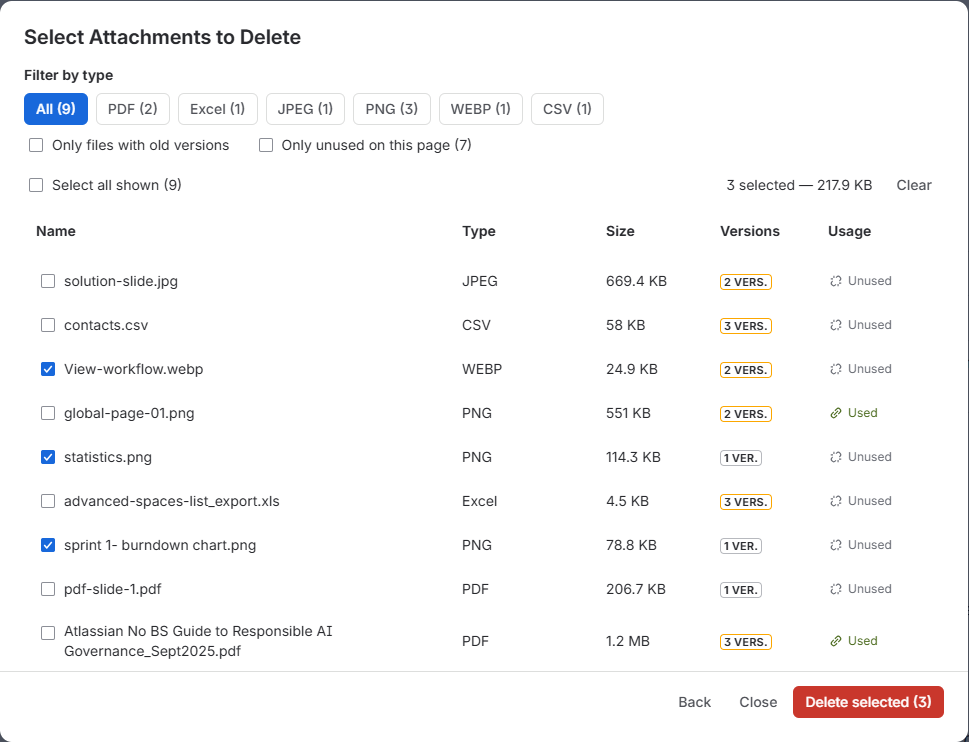
– Pick and choose — switch to a checklist to hand-select exactly which files to delete.
– Smart filters — narrow the checklist to a file type, to files that carry old versions, or to files not referenced on the current page.
– Usage hints — each file is flagged Used or Unused on this page, based on the
page’s content, so you can spot orphaned uploads.
– Friendly file types — verbose MIME types are shown as readable labels (PDF, Word, Excel, PowerPoint, Image, …).
– Select all / clear shortcuts and an instant refresh after every deletion.
Space statistics dashboard
Open Attachment Statistics** from Confluence’s global app navigation, search for a space,
and get a complete storage picture.
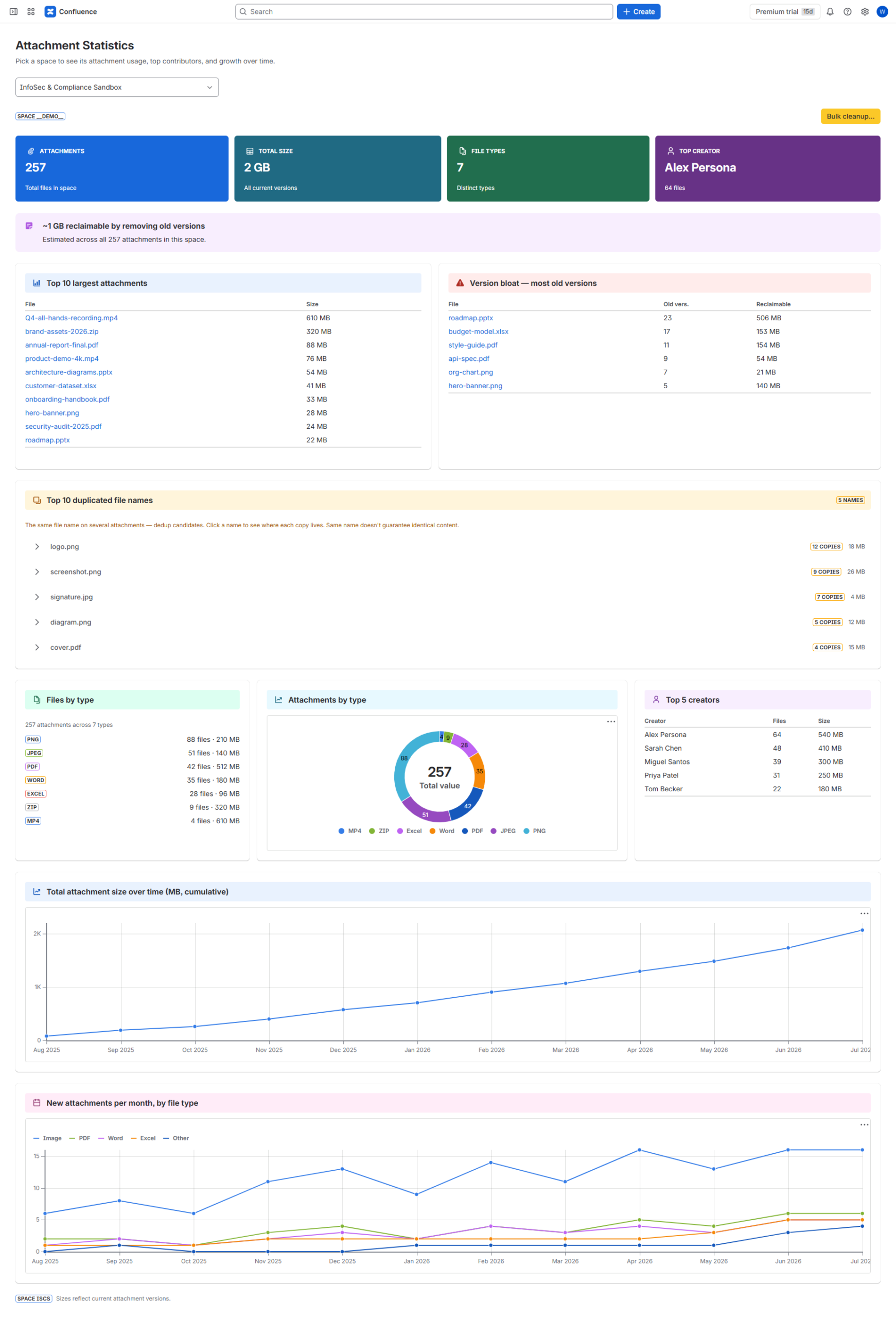
– KPI tiles — total attachments, total size, number of distinct file types, and the space’s top contributor.
– Reclaimable space — an estimate of the storage you could recover by trimming old
attachment versions, with an honest “estimated” framing.
– Version-bloat table — the attachments carrying the most historical versions, ranked
by old-version count and estimated reclaimable size, each linked to the file and its page.
– Top 10 largest attachments — your heaviest files, linked for quick review.
– Top 10 duplicated file names — the same filename appearing on multiple attachments. Expand any name to see every page a copy lives on, its combined size, and how many copies exist.
– Files by type — a colour-coded list (count and size per type) alongside a donut-chart for the same distribution.
– Top 5 creators — who’s adding the most, by file count and size.
– Growth over time — a line chart of cumulative attachment size per month, plus a multi-line chart of new attachments per month by file type.
– Deep links everywhere — every file row links to the Confluence “preview” and to the page that holds it.
– Scales gracefully — for very large spaces the dashboard analyses a capped, most-relevant set and clearly flags results as partial, so the page stays responsive.
Bulk cleanup (space scale)
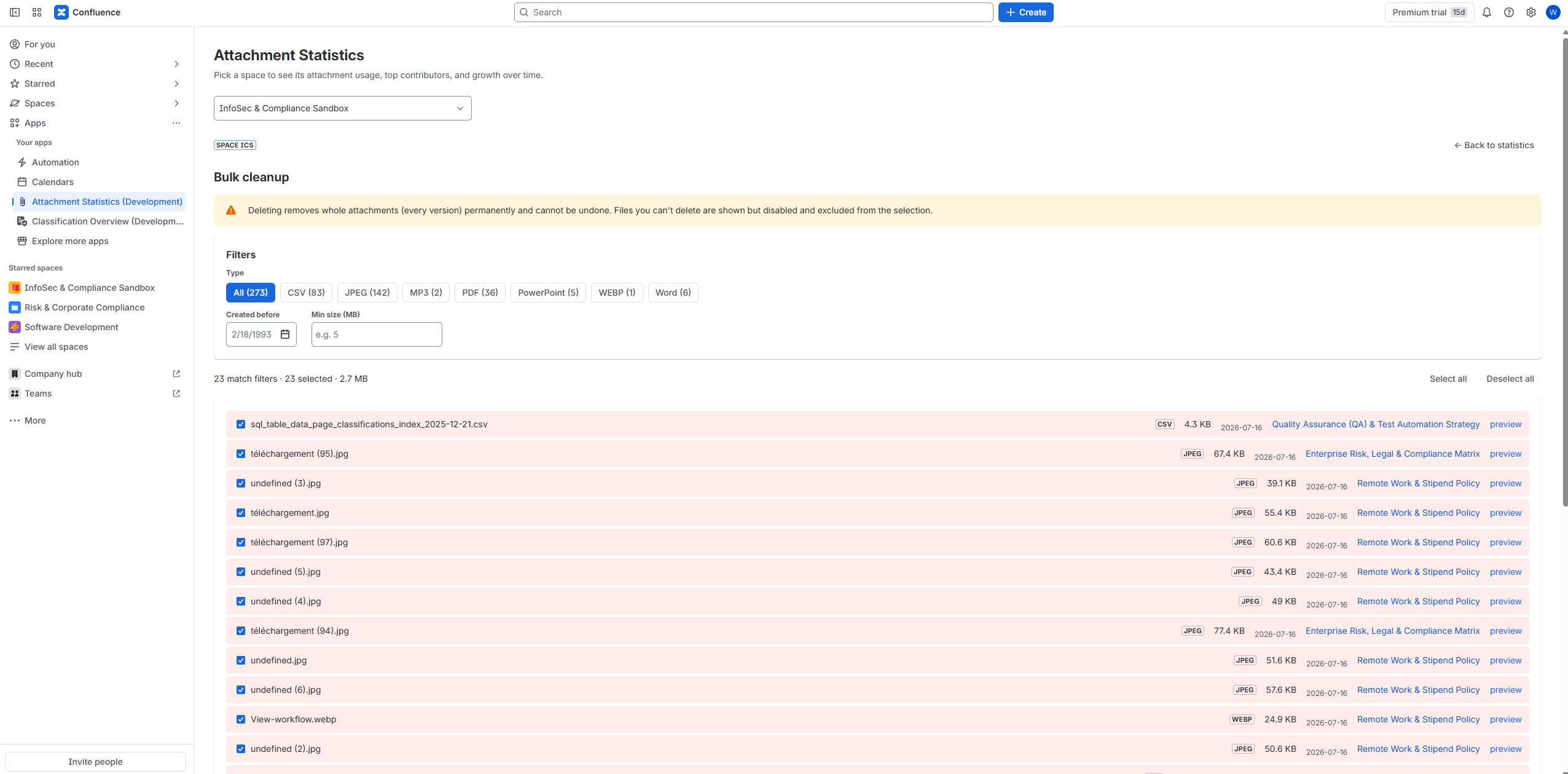
From the dashboard, switch to Bulk cleanup to remove many attachments across a space in one governed workflow.
– Targeted filters — by file type, by age (created before a chosen date), and by minimum size. The date filter is applied server-side so large spaces only load the files you’re actually targeting.
– Review before you delete — the matched files are listed for review (up to 200 at a time so the set always stays reviewable); deselect any you want to keep.
– Permission-aware selection — files you don’t have permission to delete are shown but disabled and excluded, never silently attempted or hidden.
– Live selection summary — running count, total size, and how many matches you can’t delete.
– Type-to-confirm — deletion is armed only after you type the “space key”, preventing accidental mass-deletes.
– Clear results — after running, you see how many files were deleted and how many failed, and the dashboard refreshes automatically.
Admin audit log
A dedicated, administrator-only page under Confluence global settings gives full accountability for every deletion the app performs.
– Complete coverage — records all delete operations: per-page delete all and delete selected, and space-level bulk cleanup.
– Rich, per-operation entries — timestamp, the acting user’s full name, a Space / Page scope badge, the space and page involved, the number of files deleted, and the names of the deleted files.
– Filter by space — a searchable space selector, plus an “All spaces” view.
– Chronological & paginated— newest-first, with Load more to browse history.
– Expandable detail — open any entry to see the file list; page operations list the files once (they share a page), while space operations show each file next to its page.
– Friendly timestamps — recent events read as “3 min ago” / “Yesterday, 14:47”, older
ones as a full date.
– Admin-only visibility — the page lives in global settings, so only Confluence administrators can see it.